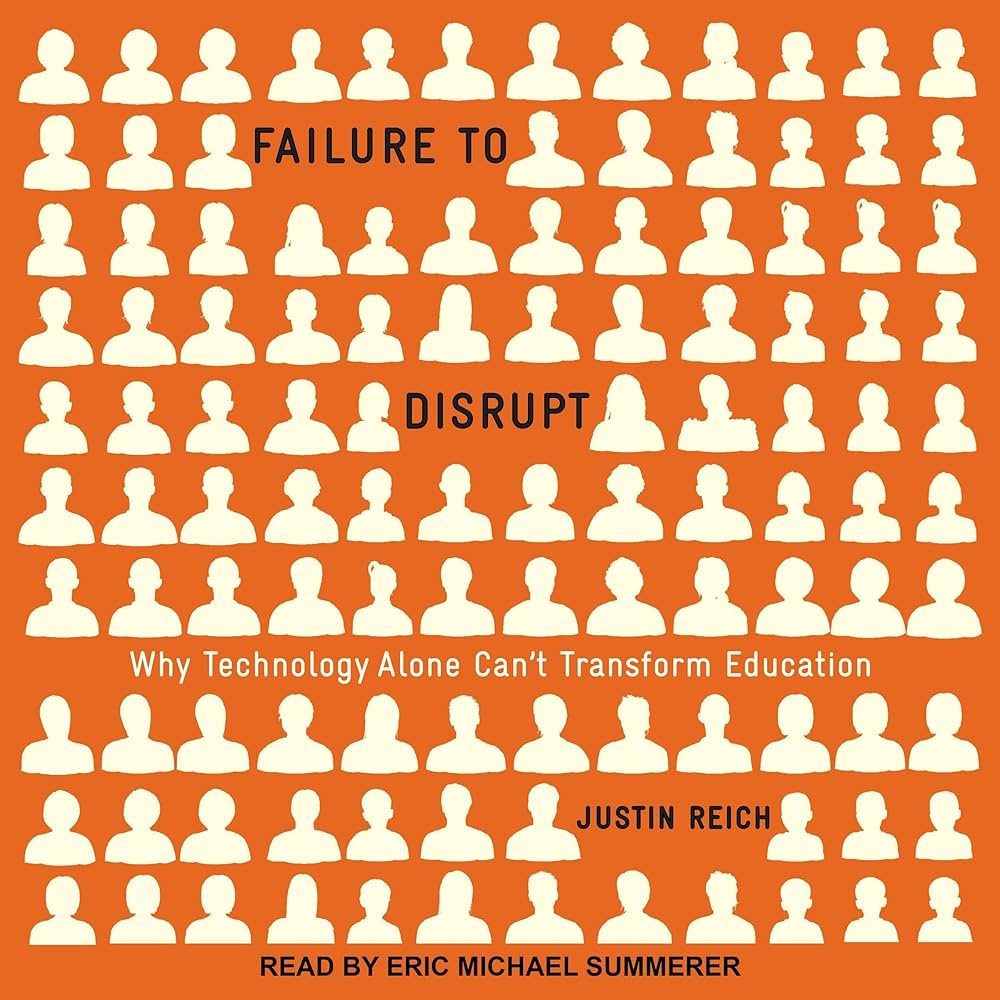
I have really enjoyed reading Failure to Disrupt: Why Technology Alone Can’t Transform Education by Justin Reich. The first four chapters have covered educational technologies that were supposed to rewrite or “disrupt” the standard model of face-to-face teacher-led classroom instruction: Massive Open Online Courses, Adaptive Tutors and Computer-Assisted Instruction, Peer-Guided Learning and Networked Learning Communities, and Learning Games. Though each of these technologies hyped fundamental revolutions in education, none of them delivered on those promises. The technologies provided additional tools for teachers to use but did not supplant the need for the pedagogical soundness and responsiveness of a competent teacher. Any gains the technologies delivered were offset by drawbacks specific to that technology.
Massive Open Online Courses (MOOCs)
Massive Open Online Courses, or MOOCs, are university-level asynchronous online courses offered by top universities through a storefront (Coursera, edX, and others) that supplied a built-in Learning Management System (LMS) that included auto-assessments. These storefronts allowed anybody, anywhere, to sign up for college-level video-recorded courses taught by the best professors from top universities. This delivery method allowed for thousands of students from all corners of the globe to casually take desired classes à la carte without the need for college entrance requirements. If successfully completed, the MOOC would provide a certificate as proof of skill competency on resumes.
The deficiencies of MOOCs have become apparent over the years. Due to the large number of students in any class, grading had to be done electronically through the LMS. Auto-grading, at least until the evolution of Large Language Model (LLM) Artificial Intelligence (AI) chatbots, has not been able to provide the same quality of assessment that an in-person teacher-led class could. Up until recently, auto-grading limited the types of assessments to true/false, multiple choice, and other types of evaluation that had clear right or wrong answers that the program could evaluate. Process-driven assessments, essays, and other creative task outputs could not be evaluated through auto-grading. Whether or not using AI autograders will work in these types of classes is currently unknown.
Employers viewed MOOC course certificates as less desirable than traditional college courses for proof of subject competency. In response, many universities offering MOOC classes have devised online degree and micro-degree programs. This led MOOCs to lean toward becoming Online Program Managers (OPMs) to develop and assist in the marketing of online courses offered through standard university settings. This movement folded MOOCs back into the traditional university experience, but delivering online courses and content instead of in-person classes. The MOOC movement proved to be less of an educational revolution, but it did allow colleges and universities to offer higher-quality pedagogically sound online courses.
MOOCs also failed to revolutionize education due to low completion rates. The students who did complete courses were generally older, already college-educated, and employed. The self-regulation strategies needed to complete a MOOC course were inherent only in students from the higher socioeconomic classes. This undermined the initial goal of MOOCs successfully bringing higher education to the masses. MOOCs used in K-12 online and credit recovery programs have had dismal results, often worse than the lowest-performing schools.
The current consensus is that MOOCs, though they do fill gaps in education, have not disrupted traditional higher or K-12 education. Though MOOCs do offer educational opportunities that might not exist otherwise, they have not created a revolution in traditional education. Perhaps many of the pitfalls inherent to MOOCs will be solved with advances in AI technology over the coming decades, but for now, they simply did not deliver on the hype.
Adaptive Tutors and Computer-Aided Instruction
This book was written before LLM AI chatbots were developed. AI chatbots will need to be developed into comprehensive adaptive tutors and support other computer-aided instruction programs, then implemented and studied before any conclusions can be made. Many of the example programs cited in the book are old enough to be currently deprecated. AI brings a host of new concerns into education, including proper usage, proper prompt engineering to reduce hallucinations, concerns over accumulated student data privacy, and improper cognitive offloading that actually negatively affects learning outcomes. At this point, more AI development and rigorous study of AI in educational settings need to be done before further discussion. Again, there is massive hype around AI being “the” disruptive educational technology, but for now, the jury is out.
Peer-Guided Learning and Networked Learning Communities
Peer-Guided Learning and Networked Learning Communities were developed from a strong sociocultural connectivism perspective to include very personalized, hands-on social learning communities where people with like interests can learn together and from one another. The educational theory that learning occurs in networks of people led to the idea that if more and denser learning networks were established, more learning would take place. Participants share blogs, wikis, and social media accounts that further the learning community for a specific subject.
One of the challenges of these peer-guided learning and networked learning communities was the additional technical savvy required to set up, effectively interact with, and find desired information on all of the different social media platforms. Few people had the skill or time to do this. The book discusses RSS feeds as a way of joining and staying plugged into peer-guided learning and networked learning communities, but RSS feeds are currently passé and unused. Newer “walled garden” platforms such as Discord, Substack, Facebook Groups, Slack, and Zoom are currently used for learning communities.
Research has shown that traditional instruction results in better learning outcomes than the more experimental experiential approach taken by peer-guided learning and networked learning communities. Students are often overwhelmed by topic information without a clear understanding of the needed process steps that are simplified and taught in traditional education. Overall, students can demonstrate some higher-level and deep learning skills, but generally master new skills better in traditional instruction. Smaller scaled peer-guided and networked learning communities can be incorporated into traditional instruction with better results, but again this did not result in a total educational disruption.
Learning Games
Learning games were also hyped as the next great thing that would disrupt traditional education. Learning games, also known as edutainment and educational gamification, promised immersive educational experiences through digital game playing. It was argued that students would remain in a Vygotsky “sweet spot” of learning through automatically adjusted levels, recursive spaced repetition, and highly engaged players. However, skills obtained through learning games have not shown to transfer well to real-world tasks. Better results have been achieved through incorporating small amounts of learning games within traditional educational settings. Again, this technology failed to disrupt traditional in-person teacher-led instruction.
Personal Reflection
Before reading this book, I did not know that, as these technologies were introduced, traditional education was anticipated to be disrupted. Perhaps these technologies’ original promises were grossly overestimated, or traditional education was underestimated. I have always looked at hype as advertising and a way to draw attention, always requiring a “buyer beware” attitude.
During my children’s education, we used all of these technologies, but under a teacher’s or my direction. The more I learn about technology, the more convinced I become of the absolute need for student/teacher or student/tutor connection, especially one-on-one. Small class sizes and individual tutoring are the keys to academic success, especially for students who struggle or have any differences not in the middle of the bell curve. Unfortunately, this is also the most expensive option for K-12 schools to provide.
Reference
Reich, J. (2020). Failure to disrupt: Why technology alone can’t transform education. Harvard Education Press.
Leave a Reply